About this course
The follow-on term for students who have finished Claude Code Bootcamp I and want to go from “built one app” to “engineer who ships.” Students take on a larger, real-world project (extending the LMS with quizzes and grading, or building a new full application), planned as features across the semester. They go deeper on fundamentals (APIs and third-party integrations, more data modeling, testing, and reading larger codebases) and on the agentic workflow itself: effective project instructions in CLAUDE.md, custom command and skill workflows, subagents and parallel tasks, and disciplined git with branches, pull requests, and code review. The bar is professional: a feature is not done until someone else could maintain it.
Is this the right fit?
- Who it’s for
- Students aged 14–18 who have completed Claude Code Bootcamp I and want to ship a substantial, professional-grade project.
- Prerequisites
- Completion of Claude Code Bootcamp I, or an equivalent project the student built with an agentic workflow and can walk us through.
- Tools students use
- Claude Code, VS Code, git and GitHub pull requests, plus APIs and integrations, on school-operated accounts
Class schedule
Two weekly time-slot options, so students in Asia, the Gulf, and the Americas can all join live. Pick the one that fits; a coach confirms it when you enroll.
Times convert to your zone automatically and account for daylight saving. A coach confirms your slot when you enroll.
What students walk away with
- A substantial, tested, deployed application in a well-structured repository
- APIs and third-party integrations, and more serious data modeling
- The advanced agentic workflow: CLAUDE.md, custom commands, subagents, and parallel tasks
- Disciplined git: branches, pull requests, and real code review
- Professional habits: testing before merging and reviewing diffs critically
What students build
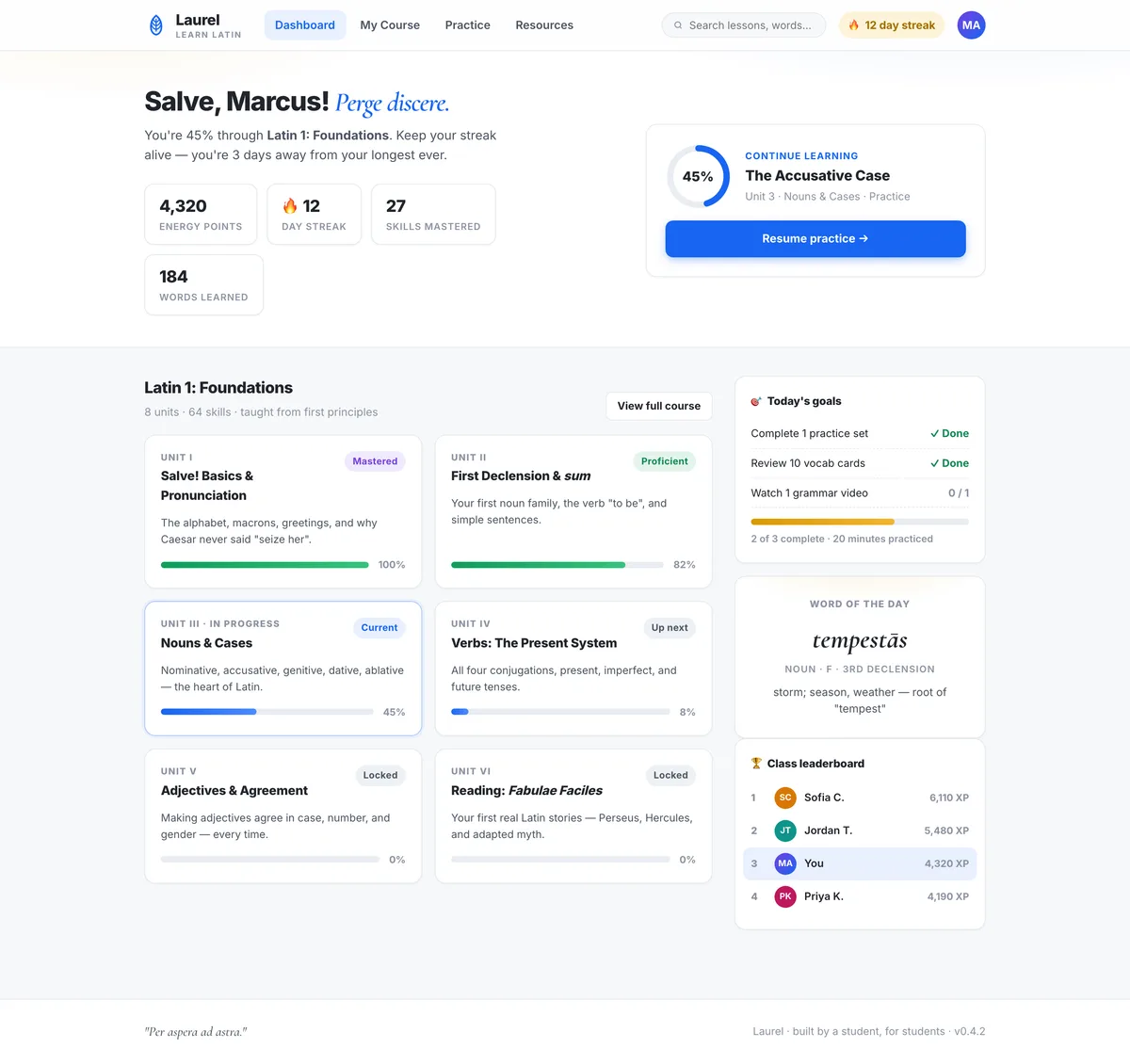
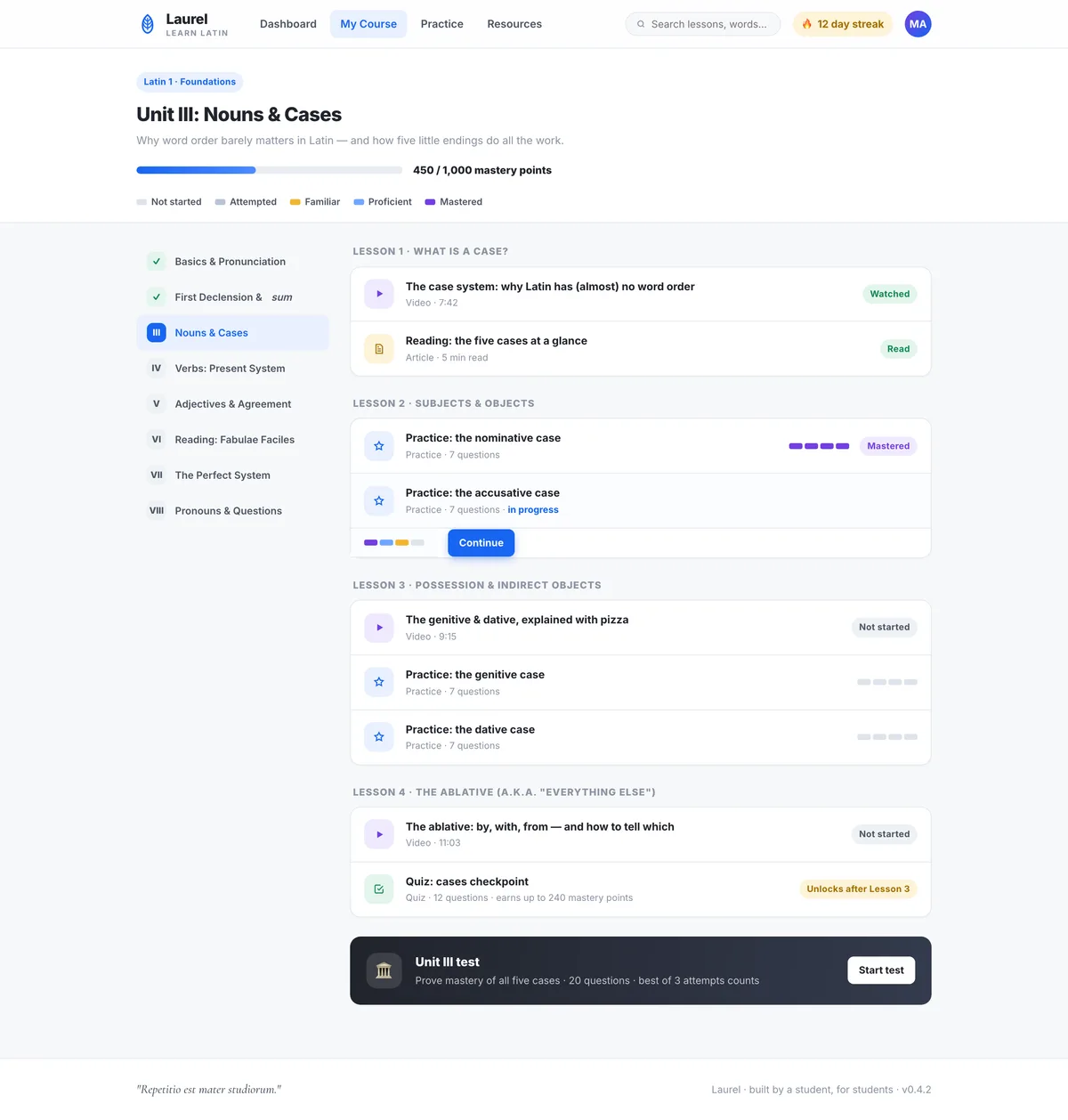
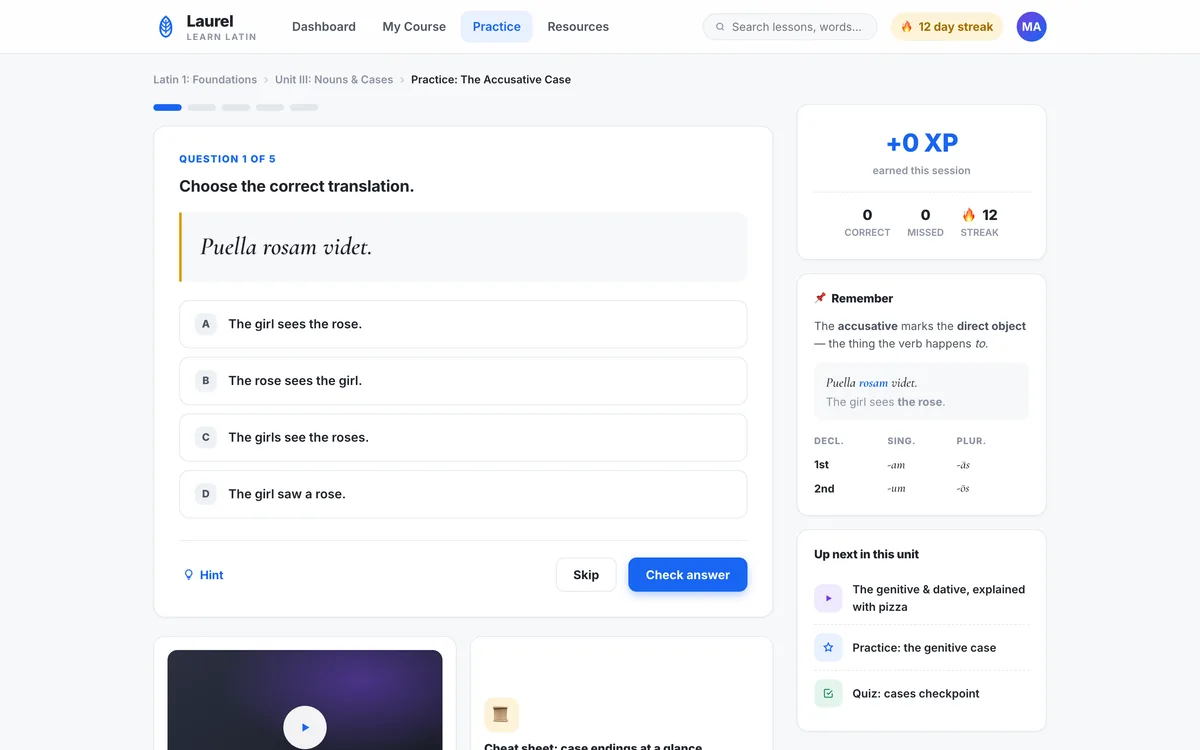
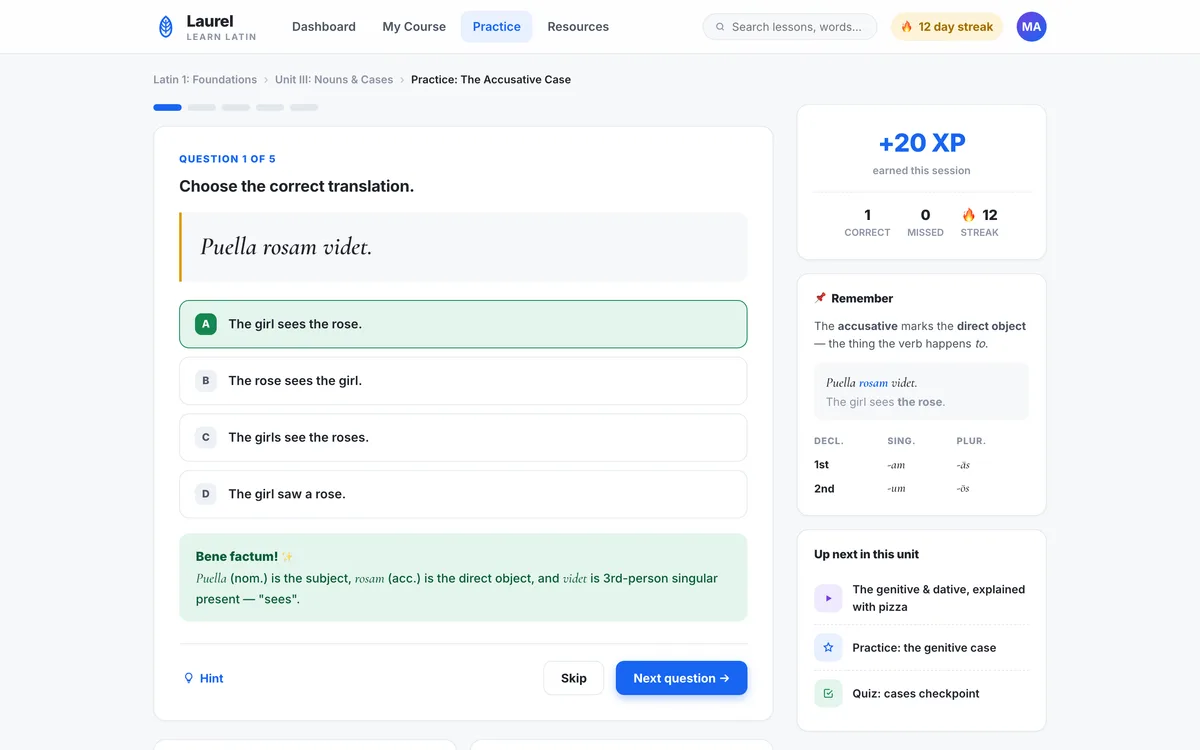
A full learning-management system: the exact kind of app this bootcamp builds
This is the project you ship in the bootcamp: a genuine learning-management system with courses, lessons, a database, student accounts, and progress tracking, built by one of our students (a high schooler in Dubai who loves Latin) in code you can read, judge, and explain.
What a session looks like
- 0:00
Standup
Each student states what shipped, what is blocked, and what is next.
- 0:10
Code review
The group reviews one student's open pull request; the author defends the decisions.
- 0:35
Paired build
Students work an issue while the coach moves between them.
- 1:25
Merge & assign
Approved work merges; the next issues get assigned.
Curriculum
Weeks 1–2: Scope a real project
Choose an ambitious project (extend the LMS or build new) and plan it as features across the term.
Weeks 3–4: APIs & integrations
Call third-party services; understand what an API is in practice. Add a real integration.
Weeks 5–6: Data modeling & tests
Model more serious data, and write tests that fail for the right reason.
Weeks 7–8: Advanced agentic workflow
Effective CLAUDE.md instructions, custom command and skill workflows, and subagents for parallel work.
Weeks 9–10: Git discipline
Branches, pull requests, and reviewing a teammate's code (and being reviewed).
Weeks 11–12: Ship & defend
Deploy, then present a tested, reviewed feature and defend the design in review.
What’s included
- 12 live small-group classes, capped at 6 students
- A shared team repository with real issues and pull requests
- Written code review on every pull request a student opens
- School-operated tooling: no raw API keys
- A public GitHub history from the course
How to join
- Purchase your seat. Choose your time-zone slot at checkout and pay securely. Classes are capped at six, so seats go in the order they’re booked.
- We confirm the details. After checkout a coach confirms your slot and asks a few quick questions so the first class is pitched right for your child.
- Sit the first class risk-free. If it’s not the right fit, tell us after that class and we’ll refund you in full.
Not sure yet? Book a free consultation or email info@redwoodacademy.ai and a coach will help you choose.
Frequently asked questions
Who is this for?
Students aged 14–18 who have completed Claude Code Bootcamp I, or who have built an equivalent agentic-workflow project on their own that they can walk us through.
How is it different from Bootcamp I?
Bootcamp I builds one app and teaches the core loop. Bootcamp II is a bigger, real-world project with APIs, testing, the advanced agentic workflow, and disciplined git: branches, pull requests, and code review.
When does it run?
It runs as the term after Bootcamp I, with the same weekend time-zone options. Bootcamp I graduates are invited first.